Despite the knowledge that certain ‘professional animal osteopaths’ and especially ‘teachers’ are supposed to have acquired, this text could opportunely and, above all, unfortunately be a revelation for them… and will therefore become… the gamma loop for dummies!
How our animals control their movements: understanding the gamma loop
Have you ever noticed your horse instantly adjusting its stride on uneven ground, or your dog regaining its balance after a misstep? This remarkable ability relies on a sophisticated nervous system called the ‘gamma loop’, which is essential for coordinating movement in our four-legged friends.
A system for automatic control of the body
Imagine the gamma loop as your pet’s automatic stabilisation system. Just as your car’s ABS continuously adjusts braking, this neural circuit constantly regulates muscle tension and balance.
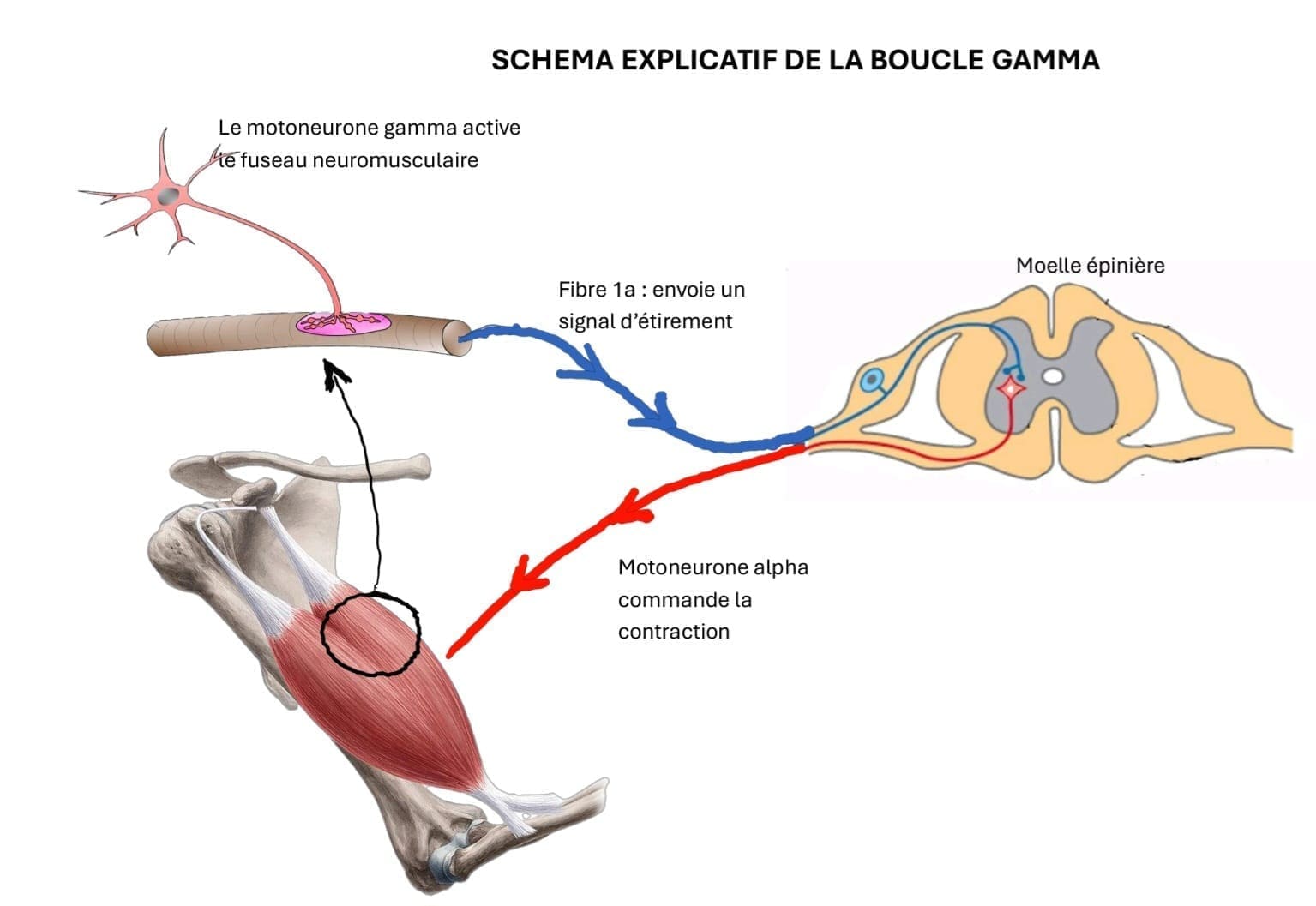
At the heart of this system are small sensors in the muscles called ‘neuromuscular spindles’. These sensors detect changes in muscle length and instantly send the information to the nervous system, which adjusts muscle contraction accordingly.
How does it work in practice?
Let us take the example of a horse trotting. With each stride
Muscle sensors detect stretching and contraction.
- L’information remonte vers la moelle épinière
- The nervous system automatically adjusts the force of contraction.
- The horse maintains its balance and pace.
- Joint and periarticular sensors inform the brain about the position of the joint. To be placed after the first sentence.
This process is repeated thousands of times per minute, without the animal having to consciously think about it!
When the system malfunctions
Sometimes, following trauma, a joint that “moves out” very quickly beyond its physiological limits, prolonged poor posture, or simply age-related conditions, this system can become disrupted. The signs are varied:
For the horse’s:
- Disorders or lack of action
- Stiffness or unusual resistance in various exercises
- Asymmetry in gait, etc.
For the dog’s :
- Intermittent lameness with no apparent cause apparent
- Changes in posture
- Reluctance to certain movements
- Disruption to certain sporting or work activities
The therapeutic approach of etiopathy
Animal etiopathy offers a manual approach to help restore the proper functioning of this system. Through precise technical movements, the practitioner:
- Solicits the various sensors of the system
- Release the tension in your muscles
- Helps the body or a part of it to regain its natural balance
It is a bit like “resetting” the movement control system, allowing the body to regain its normal automatic responses.
The technical gesture used on one or more joints thus becomes a reset” of the system governing them.
The benefits observed
Owners report often after the sessions:
- Improved fluidity of movement
- A reduction or disappearance of lameness
- A better action
- More comfort in daily exercises
An evolving approach
This therapeutic approach is based on solid scientific knowledge while remaining respectful of animal welfare. Research continues to better understand these mechanisms and refine treatment techniques.
In conclusion
The gamma loop is a fascinating system that allows our animals to move with grace and precision. Understanding how it works helps us to better identify locomotor problems and choose the appropriate therapeutic approaches. If you notice any changes in your animal’s gait or motor behaviour, do not hesitate to consult a professional who can assess whether a dysfunction of this system could be the cause.