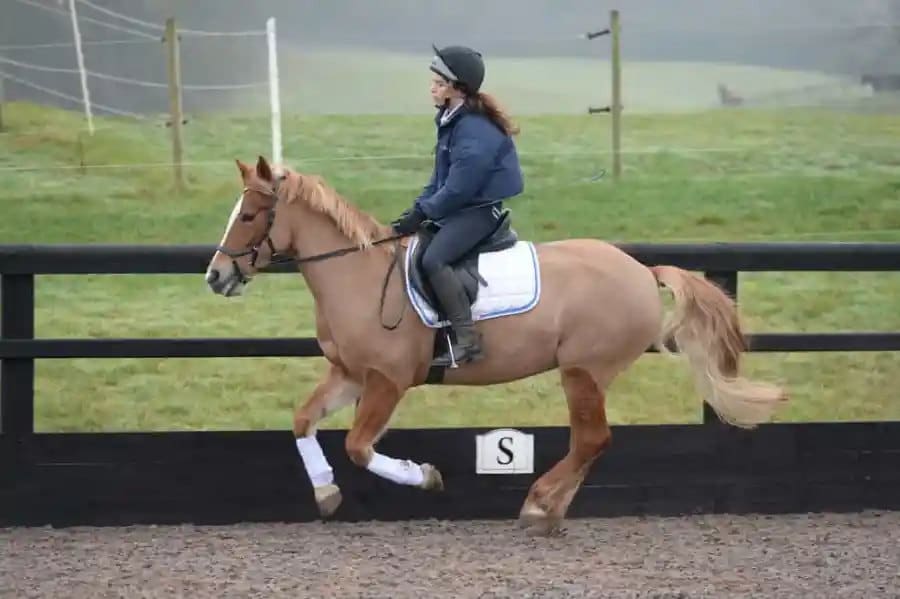
The canter, the noble and powerful gait of the horse, is a valuable indicator of its physical health and general well-being. However, some horses do “lose their stride” when cantering: their hindquarters and their forequarters are no longer in harmony, causing an unbalanced, uncomfortable gait that is often symptomatic of a more profound discomfort. Faced with this biomechanical disorder, animal etiopathy is emerging as a promising alternative solution.
What is what disunity at a canter?
Disunity refers to an imbalance between the front and hind legs of a horse when cantering. For example, a horse can canter on the right with its front legs (right foot forward) and on the left with its hind legs. This defect in harmony, sometimes intermittent, may be caused by:
- Pain or restriction of the joints;
- Compensation for a muscular or postural imbalance;
- A bad habit due to an upbringing or training that is inappropriate;
- A vertebral blockage that hinders freedom of movement.
The origin of the problem is often more complex than it appears, and this is where etiopathy finds its relevance.
Animal etiopathy: a manual and systemic approach
Etiopathy is a manual discipline based on a rigorous understanding of anatomy, physiology and causality. of physiology and of the causality of mechanical disorders. It considers the body as a whole, where each dysfunction may have an origin far from the painful area.
In animals, and particularly in horses, the animal etiopath does not content himself with relieving a symptom; he seeks the root cause of the imbalance. For a horse that loses its rhythm when cantering, this means conducting an in-depth analysis:
The pelvis and hips are often involved in posterior engagement disorders.
The spine, particularly the thoracic and lumbar vertebrae
Why consult an animal etiopath?
The benefit of animal etiopathy lies in its action at the root of the problem. Whereas conventional treatment might be limited to massage or local adjustment, the etiopath will identify a chain of dysfunctions and treat them one by one to restore overall coordination.
In the case of a horse that loses its stride when cantering, an animal etiopathy session can help to:
- To release spinal blockages or joint blockages;
- To restore mobility to the pelvis or rib cage;
- To improve the horse’s proprioception (awareness of the body in space).
- To promote better recovery and more open engagement from the back.
A complement to conventional treatments
Far from opposing veterinary medicine, animal etiopathy positions itself as an intelligent complement. It is often used when clinical examinations have not revealed any obvious pathology, but the horse shows signs of discomfort or poor performance.
Thus, for a horse that becomes disunited at a canter without a clear veterinary cause, consulting an animal etiopath can provide some answers concrete and a return to a locomotion fluid and efficient.
Conclusion
A disunited canter is not a inevitability. It is often body language that expresses a profound imbalance. Rather than treating the symptom on the surface, animal etiopathy offers a comprehensive understanding of the problem and a targeted, gentle and lasting solution. With a vision that respects horses and their physical integrity, this approach can make all the difference.
What if, for your horse, etiopathy was precisely the key to regaining harmony?