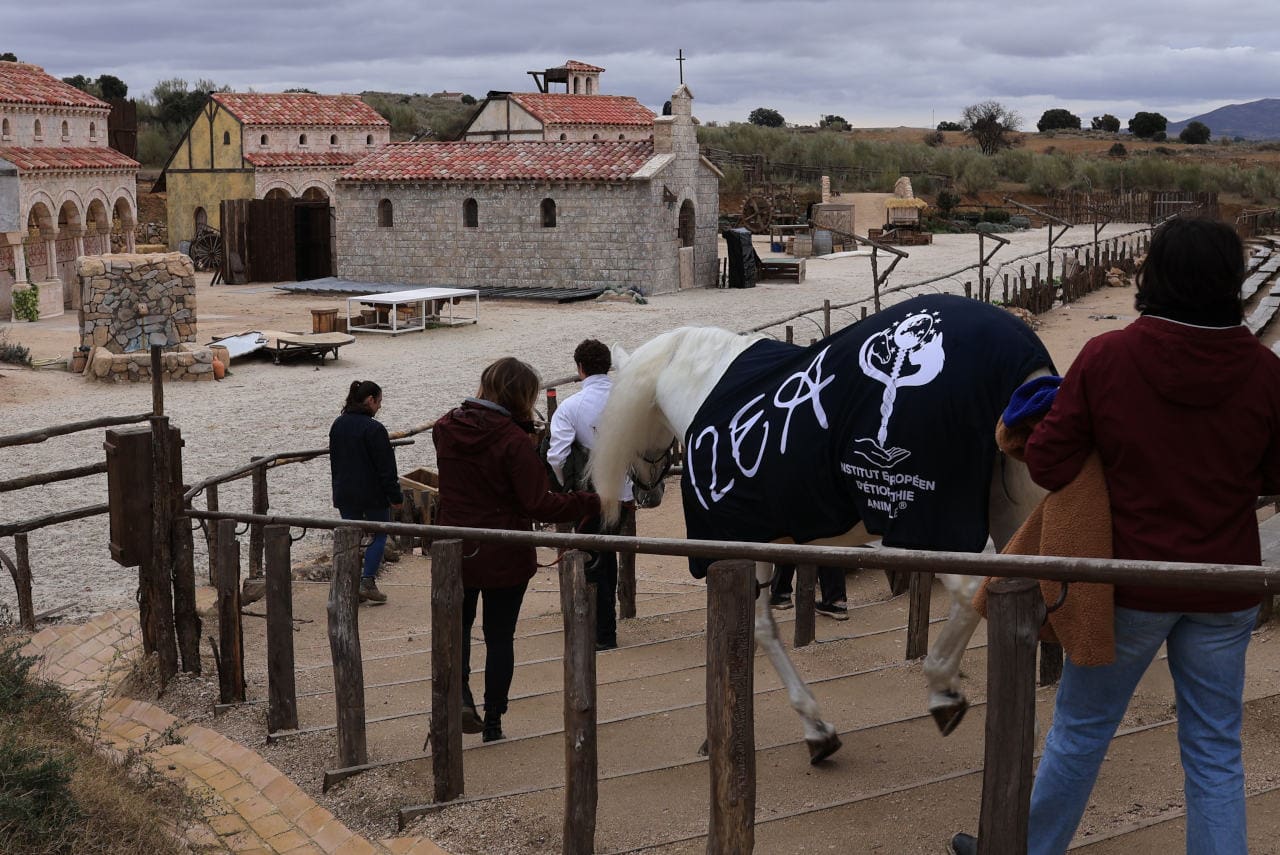
11 pm, somewhere beneath the ramparts of Toledo. The 6,000 spectators at El Sueño de Toledo are making their way back to their cars. In the stables in the park, the last horses from the evening show are being unharnessed. Tomorrow evening, they’ll do it all again. No one will ask this Purebred Spanish Horse if its right hip is a little stiffer than yesterday. That is precisely where the issue lies…
Stage performers, not extras
At Puy du Fou España, the stables are home to 90 horses. Every evening, around thirty of them take to the five-hectare stage of the night-time show, alongside more than 200 actors, riders and acrobats, to journey through 1,500 years of Spanish history. During the day, others take to the stage in the park’s daytime shows, right through to the equestrian jousts of *El misterio de Sorbaces*. These Spanish saddle horses, trained for live performance, put on back-to-back shows throughout the season.
The work of a show horse combines stresses that are experienced separately in traditional sport: explosive and repeated exertion, wearing a harness, varying ground conditions, noise and light-induced stress, and a daily routine spanning several months. The season is not a weekend competition. It is a long-form endurance test.
Why etiopathy, and not another approach?
Etiopathy is a method developed in 1963 by Christian Trédaniel. Its principle can be summed up in one word: the cause. When faced with a functional disorder, the animal etiopath practitioner does not stop at the visible symptom; they trace the chain of compensations to identify the mechanical origin of the problem, then treat it using precise manual techniques targeting the joints, muscles, internal organs or tissues. It is an analytical approach, almost like that of a detective, which requires rigorous reasoning and a deep understanding of anatomy and physiology. It is also a method that knows how to immediately refer the animal to a vet when other treatments are required.
In a show stable, this causal logic is worth its weight in gold. The daily repetition of the same manoeuvres creates micro-strains, followed by chains of compensation, and then asymmetries. The horse shows no signs of distress as long as its body is compensating. The etiopath, however, seeks out the first link in the chain before the last one gives way. In other words: they intervene before lameness sets in, not after.
 What the Puy du Fou model tells us
 What the Puy du Fou model tells us
The Puy du Fou group has made animal welfare a stated priority, in Toledo as well as in the Vendée, with dedicated teams of carers and daily monitoring of each horse. In France, the Equestrian Academy’s team includes a vet, a farrier and a practitioner of manual medicine, with enhanced care provided before and after each show. The principle is the same everywhere: it is the riders who raise the alarm as soon as a horse shows signs of discomfort, and the practitioner responds through analysis and hands-on treatment.
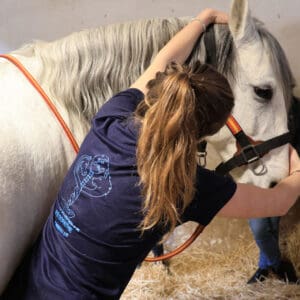
The IEEA (European Institute of Animal Etiopathy) collaborates with the equestrian teams at Puy du Fou. Students there learn the trade on real stage performers. It’s hard to find better proof that the method has its place in this type of stable: Europe’s leading equestrian troupes open their stables to these practitioners.
A specific role, not a make-work job
Let’s be clear: animal etiopathy does not replace the vet, the farrier or the equine dentist. The practitioner is independent; they do not act on prescription, but they know to refer to a vet as soon as they suspect a medical condition. Their area of expertise is functional disorders and their mechanical causes.
In a show stable, this complementary approach really comes into its own. The farrier examines the hoof; the etiopath examines how the hoof affects the hip. If the rider senses reluctance during a manoeuvre, the practitioner traces the causal chain. The vet rules out pathology; the etiopath restores mechanical function. Removing one link forces the others to work half-blind.
What your stable can take away from this
You don’t need 90 horses to apply this model. With eight or fifteen horses, the system boils down to a few key principles: a comprehensive assessment before the start of the season; regular check-ups during the competition months to monitor the emergence of compensatory movements; a simple protocol for riders and grooms to report symptoms; and a monitoring log for each horse. And a careful choice of practitioner: someone with extensive training and a reputation for rigour, who works in close contact with the animal and hand in hand with your vet.
So, does animal etiopathy have a place in a performance stable during the season? The answer is played out every evening in Toledo, in front of 6,000 spectators: horses that are responsive and docile, performing show after show without suffering any ill effects. The real question is no longer ‘if’, but ‘how’: how to organise this care within your organisation, on your own scale, from next season onwards.
The IEEA points out that the animal etiopathist is a professional specialising in functional disorders, working in a complementary capacity to the vet and other professions within the equine sector.