Scientific foundations
digistork2025-12-17T12:58:08+01:00The gamma loop explained: neurophysiological bases and applications in equids and canids
Despite the knowledge that some “professionals osteopaths animal “ but especially “teachers” that the latter are supposed to have acquired this knowledge, this text could appropriately and above all unfortunately be a a26> revelation for them....
Etiopathy is based on an in-depth understanding of the neurophysiological mechanisms that regulate muscle tone and proprioception. Among these mechanisms, the gamma loop is a fundamental element in sensorimotor regulation, the dysfunction of which may explain certain locomotor pathologies observed in equines and canines.
Neuro anatomical architecture of the gamma loop
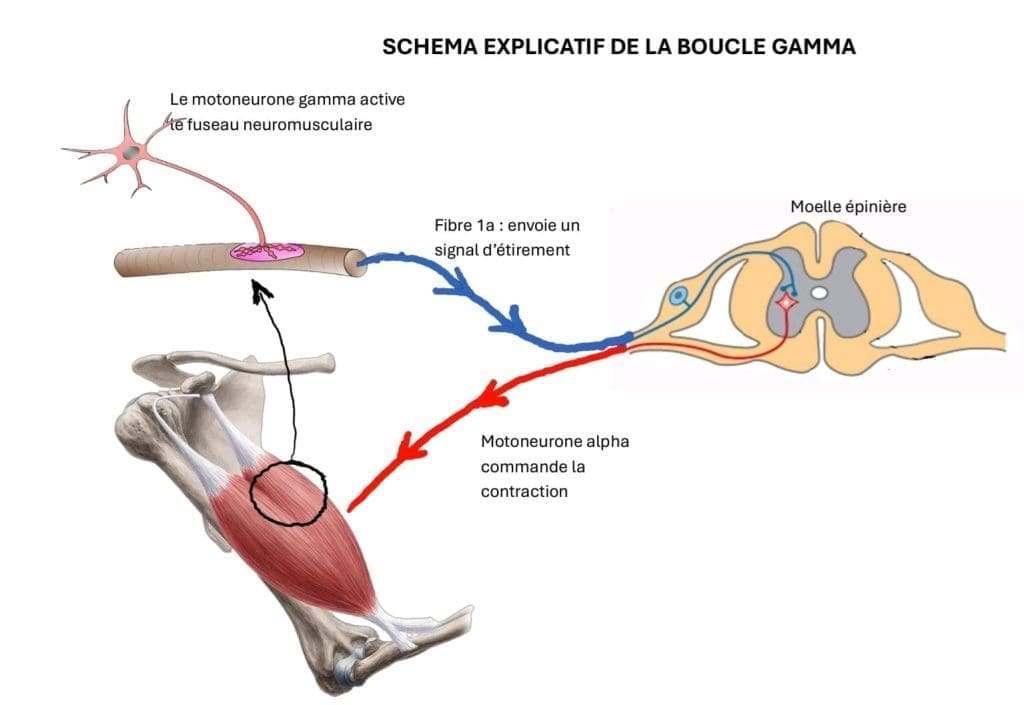
The gamma loop involves a complex neural circuit integrating spinal γ (gamma) motor neurons, neuromuscular spindles and primary type Ia afferents. Gamma motor neurons, which represent approximately 30% of the spinal motor neuron population, exclusively innervate the intrafusal fibres of neuromuscular spindles via either plaque (static gamma) or cluster (dynamic gamma) terminations.
This innervation allows modulation of the sensitivity of fusiform receptors to variations in muscle length. Activation of γ motor neurons induces contraction of polar intrafusal fibres, generating tension on the sensory equatorial region and increasing the sensitivity of the spindle to stretching.
Central and peripheral regulation
Supra-spinal control of the gamma loop is carried out via the reticulospinal, vestibulospinal and corticospinal pathways. This descending regulation allows fine adjustment of proprioceptive gain according to postural and locomotor constraints. In quadrupeds, this modulation is particularly critical for adaptation to variations in terrain and interlimb coordination.
These afferents, originating from neuromuscular spindles, project monosynaptically onto homonymous α motor neurons (myotatic reflex) and polysynaptically onto spinal interneuronal circuits. This organisation allows real-time regulation of muscle tone and joint stiffness.
Dysfunctions pathological physiological
Alterations in the gamma loop can result from several pathophysiological mechanisms. Lesions in the descending pathways alter supraspinal control, leading to changes in baseline tone. Peripheral trauma can alter the sensitivity of neuromuscular spindles, disrupting the proprioceptive feedback loop.
In equines, these dysfunctions often manifest asymmetries in locomotion, changes in the engagement of the hindquarters, the total action, or resistance to certain exercises among others .
In canines, postural compensations, intermittent lameness or behavioural changes related to proprioceptive discomfort are frequently observed.
These manifestations, both in one or the other of these species, are not exhaustive.
Applications in Etiopathy
The Etiopathic approach aims to restore homeostasis in the gamma loop through targeted manual interventions. The various technical movements used stimulate the joint and skin mechanoreceptors, generating afferents that modulate the activity of the spinal circuits via gate control and segmental facilitation/inhibition mechanisms.
Tissue normalisation techniques act directly on neuromuscular spindles by modifying intramuscular mechanical constraints. This peripheral action influences the tonic discharge of Ia afferents and contributes to the reorganisation of motor activation patterns.
Neuroplasticity mechanisms
The therapeutic efficacy of etiopathy can be partly explained by the induction of synaptic plasticity phenomena at the spinal and supraspinal levels. Repeated modulation of proprioceptive afferents can lead to a reorganisation of cortical sensorimotor maps and optimisation of locomotor patterns.
Manual techniques also promote the release of modulatory neurotransmitters (GABA, glycine) that influence spinal circuit excitability and nociceptive transmission. This neurochemical action contributes to the analgesic effect and normalisation of muscle tone observed clinically.
Clinical outlook
The integration of knowledge about the gamma loop into animal etiopathy opens up promising therapeutic prospects. Objective assessment of changes in the gamma loop using electromyography or kinematic analysis could enable accurate monitoring of therapeutic efficacy and personalisation of treatment protocols.
This approach neurophysiological to animal etiopathy is part of a a7> approach of evidence-based medicine factual, combining empirical tradition and scientific validation of beneficial mechanisms of action.
DON'T JUST TAKE IT ANYMORE, TAKE ACTION: TRAINING TO CHANGE EVERYTHING